
Why Are Some of My Landscape Lights Not Working? Common Causes and Easy Fixes
You flip on your outdoor lights, and half of them stay dark. The path lights closest to the house glow just fine, but the ones near the back fence are out. Or maybe one uplight under your favourite tree has decided to take the night off.
If only some of your landscape lights are working, the good news is that most causes are pretty simple to track down. After 24 years of servicing low-voltage systems across Santa Barbara, we have seen the same handful of issues come up again and again. Here is a homeowner-friendly walk-through of the usual suspects, plus what you can safely check yourself before calling an electrician.
Start With the Bulbs
When just one or two lights are out, the bulb is almost always the first place to look. LED bulbs last a long time, but they do eventually fail, and halogen bulbs burn out far more often, especially in coastal yards where heat and humidity shorten their life.
Swap the dead bulb with a known working one from another fixture. If the swapped bulb lights up in the new spot, you found your problem. If the old bulb works fine somewhere else, the fixture or its connection is the issue.
Check the Fixture Connections
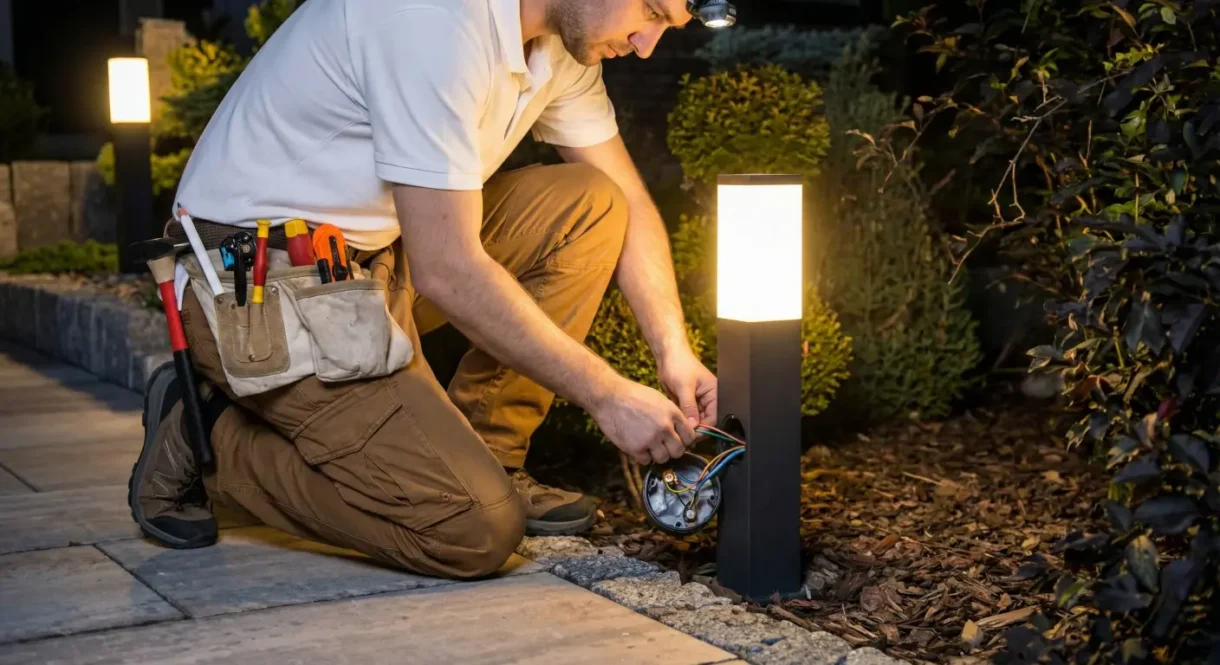
Outdoor fixtures take a beating from sprinklers, salt air, foot traffic, and curious pets. On service calls in Montecito and Carpinteria, the most common culprit we find for one or two dead lights is a connector that has worked itself loose or corroded shut. Over time, the small connectors that clip onto the main cable can loosen, corrode, or get pulled apart by lawn equipment.
Walk along the cable run and gently wiggle each fixture. Look for:
- Connectors that have come loose from the main wire
- Green or white corrosion on copper strands
- Crushed or chewed cable from rodents or shovels
- Water pooled inside a fixture housing
A loose connector can usually be reseated or replaced with a waterproof crimp connector. If you spot exposed copper, that section needs new wire and a proper splice.
Look at the Transformer
If a whole section of lights is out (say, everything past a certain point in your yard) the transformer is the next stop. The transformer steps household 120-volt power down to the 12 volts your low-voltage lights use, and it usually sits on the side of your house.
Open the cover and check:
- Is the toggle switch in the ON position?
- Is the timer or photocell set correctly?
- Is the internal breaker tripped? Reset it if so.
If the breaker keeps tripping, you likely have a short somewhere in the cable. That is a sign to stop and call a pro, since a persistent short can damage the transformer and create a fire risk. Our team handles low-voltage troubleshooting and full system repairs as part of our landscape lighting service in Santa Barbara.
Test the Timer or Photocell
Smart timers and photocells are convenient, but they fail more often than people expect. A photocell covered in dirt, leaves, or a planter that grew taller over the summer will think it is still daytime and never switch on.
Wipe the sensor clean. If the lights still will not come on at dusk, cover the photocell with a piece of black tape during daylight. If the lights fire up, the sensor itself is fine and just needs a clear line of sight. If nothing happens, the photocell or timer module probably needs replacing.
Watch for Voltage Drop
A common reason that the lights farthest from the transformer look dim or stay off is voltage drop. As current travels along the wire, it loses strength. Long runs, undersized cable, or too many fixtures on one line all make this worse. When we test fixtures at the far end of a run and read under 10 volts, the cable layout is almost always the real problem rather than the lights themselves.
Quick signs of voltage drop:
- Lights near the transformer are bright, lights at the end are dim
- Adding a new fixture made the others noticeably weaker
- Bulbs at the far end burn out unusually fast
The fix is usually re-running the cable in a loop, adding a second cable run, or upgrading to thicker 12-gauge or 10-gauge wire.
Check the GFCI Outlet
Most outdoor outlets have a GFCI built in for safety. A nuisance trip after a rainy night can cut power to your entire system before it ever reaches the transformer. Find the outdoor outlet (or sometimes one inside the garage that controls it) and press the RESET button.
When to Call an Electrician
A bulb swap or a tripped breaker is fair game for any homeowner. But once you are looking at buried cable, repeated shorts, corroded transformer parts, or a system that has just stopped working without an obvious cause, it pays to bring in a licensed electrician. Wet conditions, hidden splices, and aging wiring can hide bigger problems that are not safe to chase without the right meter and training.
If your landscape lights in Santa Barbara, Goleta, Montecito, Carpinteria, Santa Ynez, or Buellton are giving you trouble and you want them sorted out properly, get in touch with Left Coast Electric for a free quote. We are licensed (License #1010905), local, and will diagnose the issue, walk you through the fix, and have your yard glowing again before the next evening.